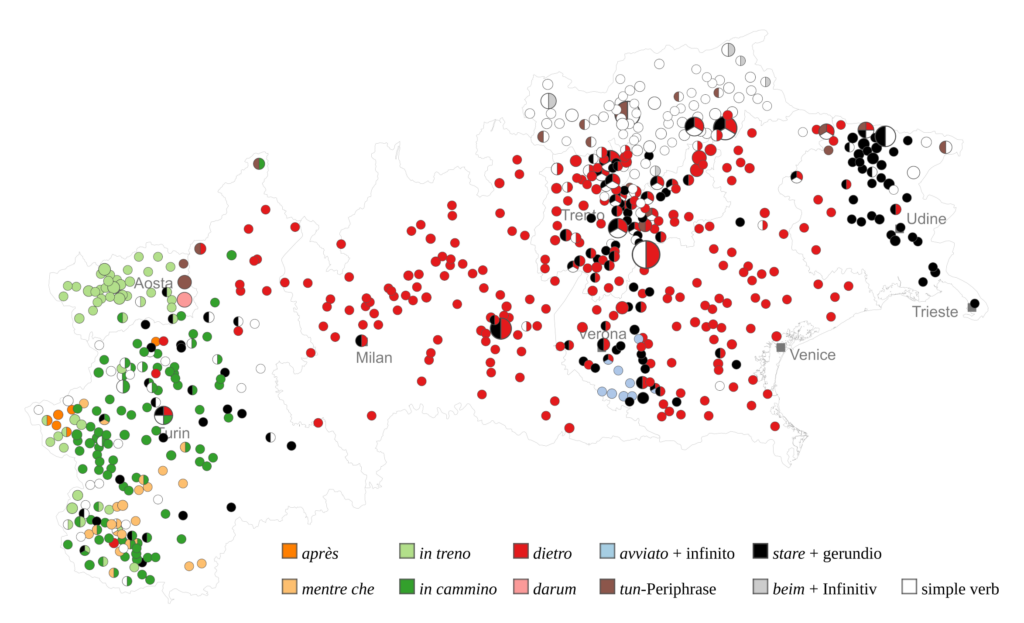
Progressive constructions in standard Italian involve a form composed of the auxiliary stare ‘to be/stay’ and the gerund of the lexical verb denoting the event. The sentence Giovanni si sta lavando i capelli (AlpiLinK stimulus S24) describes an event that takes place at the time of utterance and focuses on both its duration and on the fact that the process of washing one’s hair has not been completed yet. In many northern varieties, the use of the Italian-type gerund construction is essentially excluded or strongly reduced, as can be clearly seen in the accompanying map (based on the audio recordings of the AlpiLinK Corpus 1.1.7), where the construction “stare + gerund” is represented by black symbols.
It turns out that the most widespread construction in Northern Italy, especially in Lombardy, Veneto and Trentino, is the one with the adverb dietro ‘behind’ (in different regional pronunciations), indicated by symbols in red colour. In the following examples from central Venetan, we find the pattern “be behind + infinitive”, in which the adverb dietro ‘behind’ is realized as drio (cf. Pescarini 2024, p. 71).
Venetan (Urbana, province of Padua): Gioani (l) ze drio lavarse i cavéi
(Rabanus et al. 2026: S24_vec_U0461)
Venetan (Bonavigo, province of Verona): Giovani l’è drio lavarse i caveji
(Rabanus et al. 2026: S24_vec_U0081)
In the Lombard area – apart from a few speakers who use the gerund form – the construction with the adverb ‘behind’ is the only attested one:
Lombard (Sant’Omobono Terme, province of Bergamo): O ‘l Gian l’è dri’ che se laa i caéi
(Rabanus et al. 2026: S24_lmo_U0028)
Lombard (Briga Novarese, province of Novara): El Giuan l’è dre c’a s lava i cavéi
(Rabanus et al. 2026: S24_lmo_U0148)
Lombard (Nave, province of Brescia): Gioan l’è dré a laase i caéi
(Rabanus et al. 2026: S24_lmo_U0069)
Lombard (Busto Garolfo, province of Milan): U ‘l Giuan l’è dré laase i cavéi
(Rabanus et al. 2026: S24_lmo_U0162)
In these examples, however, a certain degree of variation can be observed: the form for ‘behind’ may select the conjunction ‘that’ and a finite clause, or the infinitive, sometimes preceded by a.
It might be interesting to add a Germanic perspective to this picture: in some minority languages, very similar constructions are found with the corresponding adverbs of German origin meaning ‘behind’. For example, in Cimbrian, a Germanic variety in contact with Romance, we find the construction “nå + infinitive”, in which nå (corresponding to standard German nach) means precisely ‘behind’. Hence, the example below can be translated literally into Italian as “il Gianni è dietro a lavare i capelli” and into English as “the Gianni is behind to wash his hair”:
Cimbrian (Luserna, Trentino): Dar Håns iz nå zo bescha ‘z har
(Rabanus et al. 2026: S24_cim_U0004)
Also in the Germanic minority varieties of Sappada and Timau, in the Friuli region, a considerable number of speakers use the construction “be behind + infinitive”, in which ‘behind’ is represented by dahinter, as shown in the examples below:
Timavese (Timau, municipality of Paluzza, province of Udine): S Hanseli is dahintar es hoar zum boschn
(Rabanus et al. 2026: S24_tis_U1845)
Sappadino (Sappada, province of Udine): Der Giovanni is dahinter de hoar zu boschn si
(Rabanus et al. 2026: S24_plo_U1702)
This construction cannot be traced back to a Germanic origin. It cannot be found in either standard German or in Tyrolean varieties. In Tyrolean the simple verb is preferred (shown in white on the map), often with the adverb grod (standard German: gerade ‘right now’), as in the following example from Bruneck:
Tyrolean (Bruneck, South Tyrol): Dr Hans wascht sich grod de har
(Rabanus et al. 2026: S24_tir_U0107)
As an alternative to the simple verb form, the construction with the preposition beim followed by the infinitive is attested in some locations (in light grey colour on the map):
Tyrolean (Sand in Taufers, South Tyrol): Johannes isch grod beim har waschen
(Rabanus et al. 2026: S24_tir_U0193)
This construction is attested both in regional German and in many German dialects, for example in those of Hesse (cf. Kuhmichel 2017, p. 132).
Speakers of the Walser variety of Issime use a construction similar to “be behind + infinitive”: instead of a form of ‘behind’, those speakers use drum (standard German darum) which means ‘around’ and is also a locative adverb (pink colour on the map):
Walser (Issime, Aosta Valley): Jean is drum z waschä locke
(Rabanus et al. 2026: S24_wae_U0989)
In Occitan, as well as in one Francoprovençal location, the progressive may also be translated with another construction involving an adverb: après (shown in dark orange on the map), which can be interpreted either as a spatial or as a temporal adverb.
Occitan (Sauze d’Oulx, province of Turin): Giovanni l’è (a)pres lavà lu cheveu
(Rabanus et al. 2026: S24_oci_U1451)
Wartburg (FEW, vol. 24, p. 178) attests the use of après ‘ad pressum’ ‘near’ with progressive value as early as Middle French. In the AlpiLinK data for Piedmontese and southern Occitan, we also find a construction that has not previously been described in the literature: “be while that + inflected verb“ (shown by light orange symbols on the map). In this construction, the progressive is expressed by means of the conjunction mentre (che) ‘while (that)’, which standard Italian uses to introduce subordinate clauses “expressing simultaneity, whether punctual or durative“ (Rohlfs 1969, p. 176).
Piedmontese (Scarnafigi, province of Cuneo): Giovanni l’è mentre c’a s lava i cavei
(Rabanus et al. 2026: S24_pms_U1083)
Going back to the Germanic domain, another widespread strategy found in the Walser villages is the construction with the so-called “tun-Periphrase” (brown on the map), which is a form of do-support consisting of the verb tun ‘do’, used as an auxiliary, and the infinitive of the lexical verb (in dialectological studies, the progressive value of the “tun-Periphrase” is debated; cf. Kuhmichel 2017, pp. 122-124):
Walser (Formazza, province of Verbano-Cusio-Ossola): Giovanni töt z har wäschä
(Rabanus et al. 2026: S24_wae_U0038)
The “tun-Periphrase” is also found in Sappadino, Timavese, and in the data of the only Saurano speaker of the AlpiLinK Corpus
Sappadino (Sappada, province of Udine): Der Giovanni tut si di hoar waschn
(Rabanus et al. 2026: S24_plo_U1902)
Timavese (Timau, municipality of Paluzza, province of Udine): Is Hanseli tut si es hoar woschn
(Rabanus et al. 2026: S24_tis_U0762)
Saurano (Sauris, province of Udine): Der Jaku tut si s hor boschn
(Rabanus et al. 2026: S24_zah_U1671)
In Sappadino and Timavese, there is variation of the “tun-Periphrase”, the construction with the adverb dahinter ‘behind’ (see above), and the simple verb, as in the following examples (variation symbolized by the brown, red and white sections in the pie charts on the map).
Sappadino (Sappada, province of Udine): Der Giovanni bascht si de hoar
(Rabanus et al. 2026: S24_plo_U1676)
Timavese (Timau, municipality of Paluzza, province of Udine): Der Hans woscht si es hoar
(Rabanus et al. 2026: S24_tis_U1645)
Going back to the Romance domain, in other areas we find the adverbial periphrases en train de and en camin a/che, symbolized on the map with shades of green. The first one (light green), reasonably ascribed to contact with French, is found, e.g., in Francoprovençal varieties,
Francoprovençal (Roisan, Aosta Valley): Giovanni l’è(n) train de se lavi le pei
(Rabanus et al. 2026: S24_frp_U0416)
Francoprovençal (Challand-Saint-Victor, Aosta Valley): Gioanni i’ en train de lavesse le pei
(Rabanus et al. 2026: S24_frp_U0428)
and Occitan varieties:
Occitan (Pontechianale, province of Cuneo): Giuan es en train de lavas li pèis
(Rabanus et al. 2026: S24_oci_U0150)
The main aspect of variation in these constructions concerns the proclisis or enclisis – depending on the location – of the reflexive pronoun si with respect to the infinitive in the form lavarsi, translated as se lavi (literally “himself washes”) or laves-se (“washes himself”).
The other construction, i.e., the form en camin a/che (dark green on the map), is widespread across large areas of Piedmontese (cf. Telmon 1988, p. 480) and Occitan, and rarely also in Francoprovençal.
Francoprovençal (Coazze, province of Turin): Giovanni u est en camin che u’s’lava la testa
(Rabanus et al. 2026: S24_frp_U0047)
Occitan (Pomaretto, province of Turin): Giuvani l’è’n camìn a se lavà li pèl
(Rabanus et al. 2026: S24_oci_U0083)
Occitan (Roaschia, province of Cuneo): Giuan l’ès en camìn che se lava i ciavèi
(Rabanus et al. 2026: S24_oci_U0454)
Piedmontese (Borgo San Dalmazzo, province of Cuneo): Giuanni l’è in camin a laesse i cavèi
(Rabanus et al. 2026: S24_pms_U0030)
Piedmontese (Feletto, province of Turin): Giuan l’n en camin c’a s lava i cavei
(Rabanus et al. 2026: S24_pms_U0462)
A reflex of the construction is also found in the Walser varieties of Formazza and Rimella (Piedmont), alongside the aforementioned “tun-Periphrase”: “zwäck z(e) + infinitive” corresponds to being ‘on the way to + infinitive’.
Walser (Formazza, province of Verbano-Cusio-Ossola): Der Hans Jos isch zwäck z har z wäschä
(Rabanus et al. 2026: S24_wae_U0037)
Walser (Formazza, province of Verbano-Cusio-Ossola): Giovanni isch zwäck z har z wäschä
(Rabanus et al. 2026: S24_wae_U1003)
Walser (Rimella, province of Vercelli): Der Giuan isch zwäck ze waschä z har
(Rabanus et al. 2026: S24_wae_U1857)
Isch zwäck z can be translated literally into German as “ist zu/auf dem Weg zu” ‘is on the way to’.
In a limited area of the southernmost province of Verona, we find the construction “invià + infinitive” (light blue hue on the map). The following example is translated literally into Italian as “Giovanni è avviato (a) lavarsi i capelli” ‘Giovanni is set/started to wash his hair’ (cf. Bonfante 2018, p. 77):
Venetan (Oppeano, province of Verona): Giovani l’è invià lavarse i cavéi
(Rabanus et al. 2026: S24_vec_U0088)
Speakers of Friulian varieties predominantly use the construction with the verb stâ ‘stay/be’ followed by the gerund of the verb ‘wash’, as in Italian:
Friulian (Gemona del Friuli, province of Udine): Giuan si sta lavant i cjavei
(Rabanus et al. 2026: S24_fur_U0175)
A similar construction is found in the Trentino Region: “stare a + infinitive”, with the auxiliary ‘stare’ governing an infinitive preceded by a (cf. Rohlfs 1969, p. 133), thus showing a use similar to Italian:
Trentino (Contà, Trentino): Giovani el se sta a lavar i ciavei
(Rabanus et al. 2026: S24_tre_U1621)
Returning to the Friuli region, we can observe that Resian, by contrast, does not apply any of the strategies mentioned so far, but follows the Slavic-Slovenian strategy, using the verb for washing body parts in its imperfective variant, wmüvat or wmívat in San Giorgio, contrasted with the perfective variant wmet (cf. Steenwijk 1992, p. 327).
Resian (San Giorgio, municipality of Resia, province of Udine): Ǧuan an si wmüa lase
(Rabanus et al. 2026: S24_res_U1182)
For advice on individual varieties or constructions, we thank Sabrina Bertollo, Paolo Frassi, Malinka Pila and Riccardo Regis.