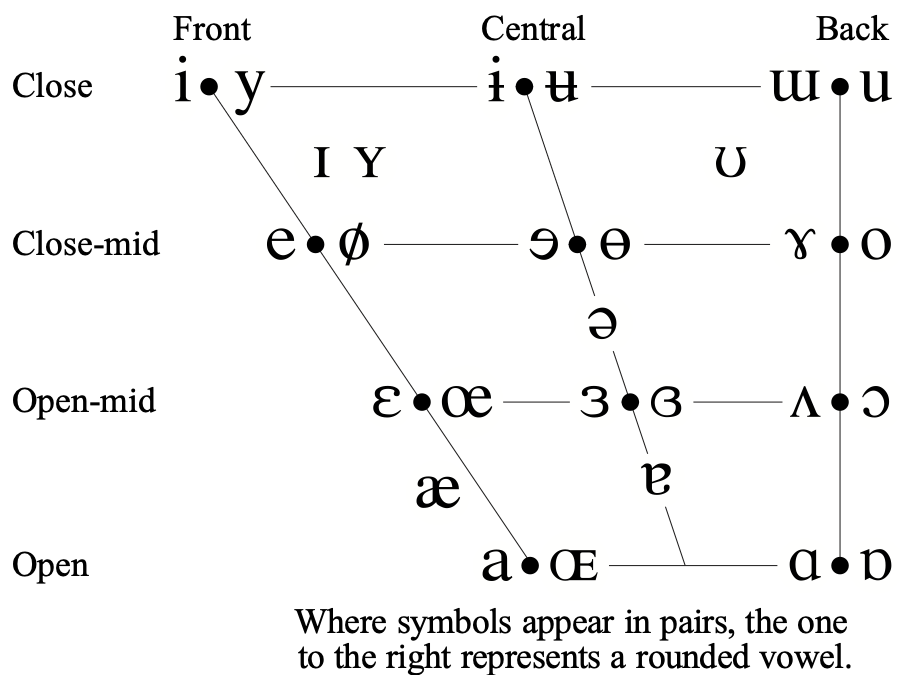
Vowels differ according to numerous features, most importantly with respect to the position of the tongue in the oral cavity (high-low, front-back) and lip rounding. In most of the world’s languages there is a correlation between the front-back dimension and lip rounding such that back vowels are rounded and front vowels are unrounded (Ladefoged & Maddieson 1996, p. 292). Standard Italian and Standard Slovenian correspond to this typologically dominant correlation. Standard German and French, by contrast, distinguish between rounded and unrounded front vowel phonemes, for example German küssen /kʏsən/ ‘to kiss’ vs. Kissen /kɪsən/ ‘pillow’. However, the dialects and minority languages in northern Italy have vowel systems that often differ from those of the related national languages.
German-Germanic: Only Cimbrian has rounded and unrounded front vowels like Standard German, because the vowels mutated by umlaut in Middle High German have been preserved. An example is the possessive pronoun unser ‘our‘), whose stem vowel in Cimbrian – unlike in the dialects which Standard German developed from – underwent analogical umlaut u > ü (cf. Klein, Solms, Wegera 2018, p. 366), as can be heard in sentence S17 Jeder fährt alleine: wir mit unserem Auto, ihr mit eurem ‘Everyone drives separately: we with our car, you with yours‘:
Cimbrian (Lusern): Aniaglas geat selbart: biar pin ünsar auto, de åndre pin aür
(Rabanus et al. 2026: S17_cim_U0004)
Cimbrian (Giazza): Onji uanz iz geat pa saine saite: barandre pit üsar auto, irandre khent pitu aur
(Rabanus et al. 2026: S17_cim_U0809)
No other historically German variety in northern Italy has rounded front vowels (except some Ahrntal and Antholz dialects in which the vowels are not, however, results of the usual umlaut processes, cf. already Kranzmayer 1960, pp. 174-175). In Tyrolean, Mòcheno (Fersentalerisch), Sappadino (Plodarisch), Saurano (Zahrerisch), and Walser German, unser had also undergone analogical umlaut. However, the umlauted vowel ü later got unrounded to i.
Tyrolean (Schlanders, Vinschgau): Jeader fohrt alloan: mir mit inserm auto un es mit enkren
(Rabanus et al. 2026: S17_tir_U0684)
Mòcheno (Palù del Fersina): An jeden geat selbschtändig: wirondre pit n insere auto irondre pit n enkher
(Rabanus et al. 2026: S17_mhn_U1436)
Sappadino: An jeader geat selberscht: mir pit insere maschin und ir pit enkhra
(Rabanus et al. 2026: S17_plo_U0874)
Saurano: An jeader geat allane: bir mit inserder macchina ir mit airder
(Rabanus et al. 2026: S17_zah_U1671)
Walser German (Formazza, Piedmont): Netweders äleinig: wir mit indscher auto un ir mit ewro
(Rabanus et al. 2026: S17_wae_U0038)
Walser German (Gressoney Saint-Jean, Aosta Valley): Wir gen sich selbsch: wir m indschi auto un ir mi owe
(Rabanus et al. 2026: S17_wae_U0290)
In Timavese (Tischelwangerisch) and Valcanale German, by contrast, the stem vowel in unser was never umlauted and remained u as in Standard German and in the Carinthian dialects, of which these two minority languages form the direct geographical continuation (cf. Pohl 1989, pp. 46, 48).
Timavese: Anias geat alana, miar mit unsarn auto unt deis mit enckarn
(Rabanus et al. 2026: S17_tis_U0766)
Valcanale German (Tarvisio): Jeder fährt für sich: mir mit unsern auto und ir mit aire
(Rabanus et al. 2026: S17_ktd_U1778)
The Romance dialects and minority languages are compared for the words for ‘fruit‘ in sentence S04 La frutta l‘hai già portata o posso portarla io? ‘Have you already brought fruit, or shall I bring it?‘ Friulian and most Venetan and Trentino dialects agree with Standard Italian in that they do not have rounded front vowels. The words fruta and pomis ‘fruit‘ are pronounced with the rounded back vowels u and o.i arrotondate u e o.
Friulian (Tricesimo, Province of Udine): Lis pomis lis atu già portadis o podìo portarlis jo?
(Rabanus et al. 2026: S04_fur_U1152)
Venetan (Treviso): La fruta a gatu sa portada o posso portarla mi?
(Rabanus et al. 2026: S04_vec_U0482)
Trentino (Predaia, Province of Trento): La fruta l’as sa portada o la porti mi?
(Rabanus et al. 2026: S04_tre_U1733)
In the vowel systems of all other Romance varieties, however, rounded and unrounded front vowels occur, though in different ways depending on the language and subvariety.
Among the Ladin varieties, only the Gadertal dialects (Badiotto) in South Tyrol have rounded front vowels (and the variety of Moena in Trentino well, but only with the sound [ø], cf. Salvi 2020, p. 70). It is doubtful that contact with German played a role here, since the Tyrolean dialects as the main contact languages do not have rounded front vowels at all, and they are also absent in Gardenese also spoken in South Tyrol (cf. Casalicchio 2024, p. 84). The other Ladin varieties agree with Italian in linking the features ‘front‘ and ‘unrounded‘. In the following examples, the rounded front vowel ö, [ø] in phonetic transcription, is heard only in Badiotto; in the other varities the rounded back vowel u is attested. Note that in the Ladin varieties of South Tyrol (Badiotto and Gardenese), forms of an underlying lexeme verdura are used for ‘fruit‘, which in Italian means ‘vegetables‘.
Badiotto (St. Martin in Thurn, South Tyrol): T‘s tö bele tut l‘ordöra cun te o dessi iö m‘la tó cun me?
(Rabanus et al. 2026: S04_lld_U0252)
Gardenese (St. Christina in Gröden, South Tyrol): Ess‘a bel purtà pea versura o dess’ pa ie la purté pea?
(Rabanus et al. 2026: S04_lld_U0172)
Fassano (San Giovanni di Fassa, Province of Trento): I fruc i asto portè tu o posse i portar gio?
(Rabanus et al. 2026: S04_lld_U0389)
Ampezzano (Cortina d’Ampezzo, Province of Belluno): I frute i asto ormai portade o pode i portà iò?
(Rabanus et al. 2026: S04_lld_U0742)
Fodom (Colle Santa Lucia, Province of Belluno): La fruta l’asto bele portada o posse la portà mi?
(Rabanus et al. 2026: S04_lld_U0494)
In the Lombard and Piedmontese dialects, as in Gallo-Romance in general, the rounded front vowels ü [y] and ö [ø] are widespread, as already noted by Biondelli (1853, p. XLVIII); in some dialects they even function as shibboleth forms (for the change [u] > [y], cf. Rohlfs 1949, pp. 102-105).
Lombard (Gazzaniga, Province of Bergamo): La früta a l’e giammò portada pöde purtela me?
(Rabanus et al. 2026: S04_lmo_U1740)
Lombard (Brescia): La früta l’e già portada o pöde purtela me?
(Rabanus et al. 2026: S04_lmo_U0393)
Piedmontese (Borgosesia, Province of Vercelli): La früta ma t’ei già purtala o pös purtela me?
(Rabanus et al. 2026: S04_pms_U1179)
Piedmontese (Montà, Province of Cuneo): La früta l’ati z-già purtala o pös purtela me?
(Rabanus et al. 2026: S04_pms_U1054)
Francoprovençal has the full inventory of rounded front vowels as in French, whereas in the central valleys of Occitan only ü [y] occurs as a rounded front vowel (cf. Rivoira 2024, p. 292).
Francoprovençal (Aosta): La frütta t’a dza portoù-la o fa la portì me?
(Rabanus et al. 2026: S04_frp_U0861)
Francoprovençal (Balme, Province of Turin): La früta ‘t l’a già purtà o pö purtela me?
(Rabanus et al. 2026: S04_frp_U1396)
Occitan (Limone Piemonte, Province of Cuneo): La früto l’as dzo pourtò o pö purtela me?
(Rabanus et al. 2026: S04_oci_U1352)
In the AlpiLinK audio recordings of Resian, the sound [œ] can be heard, namely in the word for ‘child‘ in sentence S20 Alcuni bambini piccoli parlano ancora in dialetto ‘Some small children still speak dialect‘, which in Standard Slovenian is otrok and which is written for San Giorgio Resian by Steenwijk (1992, p. 329) as wotrók.
Resian (San Giorgio, Resia, Provinz Udine): Kárje málo wotrök pravi šćalë́ pö nas
(Rabanus et al. 2026: S20_res_U1180)
Thanks to Sabrina Bertollo, Ilaria Driussi, Riccardo Ferracin, Alberto Ghia, Malinka Pila, Ruth Videsott and Francesco Zuin for help with transcriptions.